The rules
Electric Gate Rules in Banbury: Planning and Wiring
Planning permission, conservation areas, dropped kerbs and electrical regulations can each touch an electric gate. Wording from the Planning Portal, Cherwell District Council, Oxfordshire County Council and legislation.gov.uk is set out below as published, and none of it rules on a specific job.
Planning permission and gates
The Planning Portal sets out when a gate, wall or fence does not need an application, and lists conditions:
You will not need to apply for planning permission if you wish to erect a new; or alter, maintain, improve or take down* an existing fence, wall or gate if the following conditions are met: … it is next to a highway used by vehicles (or the footpath of such a highway) and it would not exceed one metre in height (from ground level); or … it would not exceed two metres in height (from ground level) if elsewhere; or …
Source: Planning Portal, fences, gates and garden walls, viewed 19 November 2026.
no part of the site is a listed building or within the curtilage of a listed building. … the right to put up or alter fences, walls and gates has not been removed by an article four direction or a planning condition. If any of these conditions are not met, then you will need to apply for planning permission.
Source: Planning Portal, fences, gates and garden walls, viewed 19 November 2026.
The same page adds that In a conservation area, you might need permission take down a fence, wall or gate
. It does not say whether an electric gate, with its pillars, motors and keypad, counts as an alteration under these conditions, or what height a gate on a given drive reaches. Those are for the planning authority, which for Banbury is Cherwell District Council.
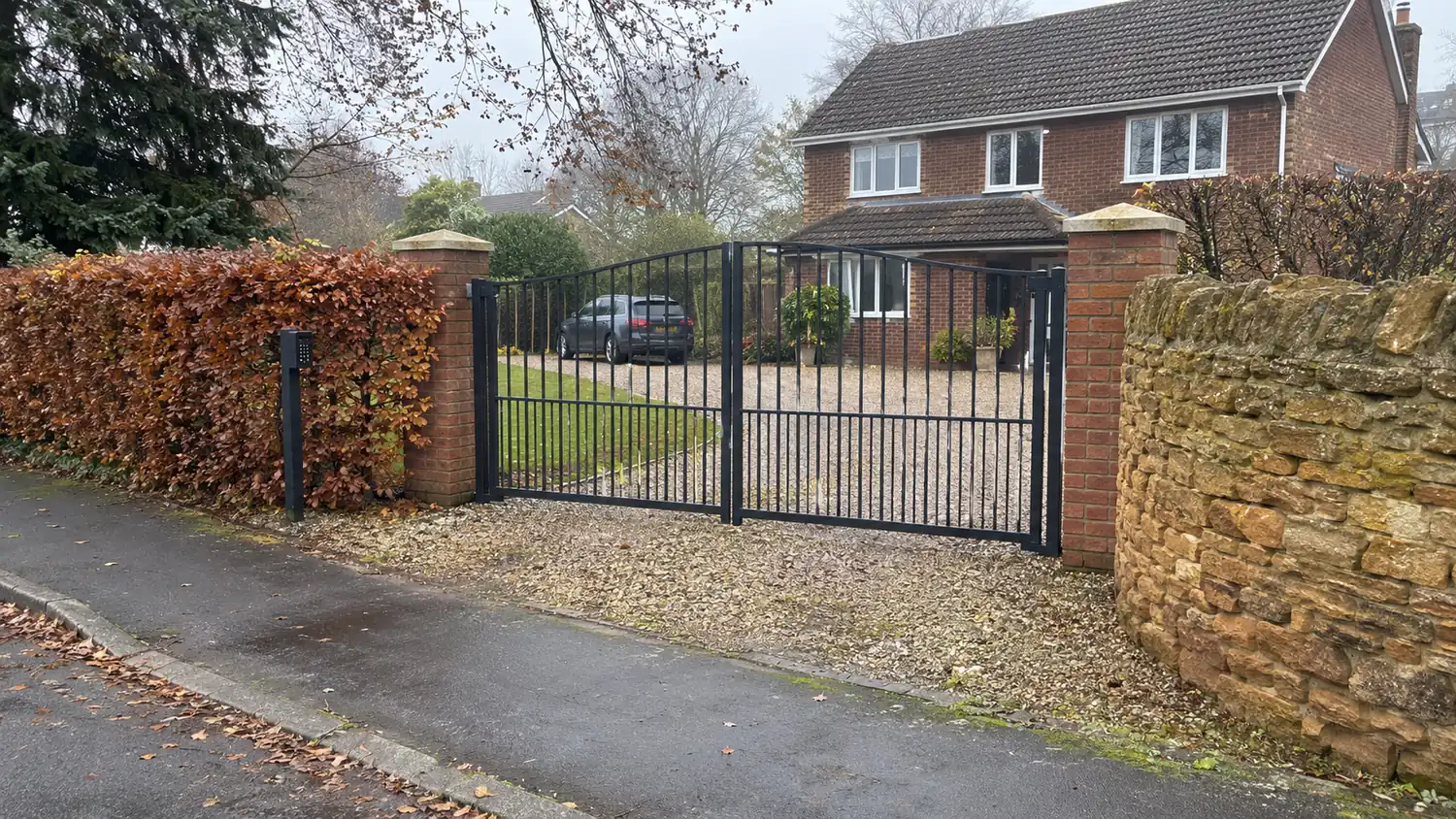
Conservation areas
Cherwell District Council defines a conservation area and gives a count for the district:
A conservation area is an area of special architectural or historic interest, with character or appearance that is desirable to preserve or enhance.
Source: Cherwell District Council, conservation areas, viewed 19 November 2026.
There are currently 60 conservation areas in Cherwell, reflecting the high quality environment of the district. Conservation areas are designated for many of the villages as well as for the market towns of Banbury and Bicester.
Source: Cherwell District Council, conservation areas, viewed 19 November 2026.
The council’s heritage advice page recommends starting with the appraisal for the area in question:
Searching your local Conservation Area Appraisal is a good starting point before planning any external works.
Source: Cherwell District Council, heritage advice, viewed 19 November 2026.
Whether an address lies in a conservation area, or carries an Article 4 direction, is beyond this page. The council’s own pages and its design and conservation team can answer that.
Dropped kerbs
A gate across a new or widened entrance can also involve the highway. Oxfordshire County Council says who deals with dropped kerbs and what it asks of applicants:
We are responsible for permitting construction, or alteration, of dropped kerbs (otherwise known as vehicle access crossings or crossovers) for domestic and industrial use.
Source: Oxfordshire County Council, dropped kerbs, viewed 19 November 2026.
You will need to contact your Local Planning Office (i.e. your district council) to check whether specific planning permission is also required. This applies in all cases, including proposals to modify an existing access.
Source: Oxfordshire County Council, dropped kerbs, viewed 19 November 2026.
Wiring and Part P
Running a cable to a gate is electrical work. The Building Regulations deal with electrical safety in Part P, and its requirement and its scope are short:
Reasonable provision shall be made in the design and installation of electrical installations in order to protect persons operating, maintaining or altering the installations from fire or injury.
Source: Building Regulations 2010, Schedule 1, Part P, P1, viewed 19 November 2026.
The requirements of this Part apply only to electrical installations that are intended to operate at low or extra-low voltage and are— … (d) in a garden or in or on land associated with a building where the electricity is from a source located within or shared with a dwelling.
Source: Building Regulations 2010, Schedule 1, Part P, Application, viewed 19 November 2026.
Whether a particular gate circuit falls within those words is a matter for building control and the electrician. GOV.UK publishes the Approved Document behind Part P: the GOV.UK page for Approved Document P. Ask which competent person scheme the electrician belongs to, and check it on the scheme’s own site through GOV.UK’s page on competent person schemes.
Where to ask
- For planning, conservation areas and Article 4: Cherwell District Council, through Cherwell District Council, heritage advice.
- For a new or widened dropped kerb: Oxfordshire County Council, dropped kerbs.
- To work out which authority covers a postcode: the Planning Portal’s lookup for your local planning authority.
Put the question in writing and keep what comes back. An installer’s view on permission is an opinion; the answer from the council is the one that counts.
Rules sorted, or not yet?
Tell the form if the property sits in a conservation area, is listed, or is neither.